Last updated: 2026-09-01
When manufacturing products in China, many foreign companies focus on price, tooling, and production timelines — but overlook one of the most important legal issues: protecting their intellectual property BEFORE disclosing it to Chinese manufacturers.
Many overseas buyers mistakenly use a standard NDA (Non-Disclosure Agreement) drafted under U.S. or European law. However, such agreements are often difficult or impractical to enforce against Chinese suppliers.
In China manufacturing transactions, a properly drafted NNN Agreement is usually far more effective.
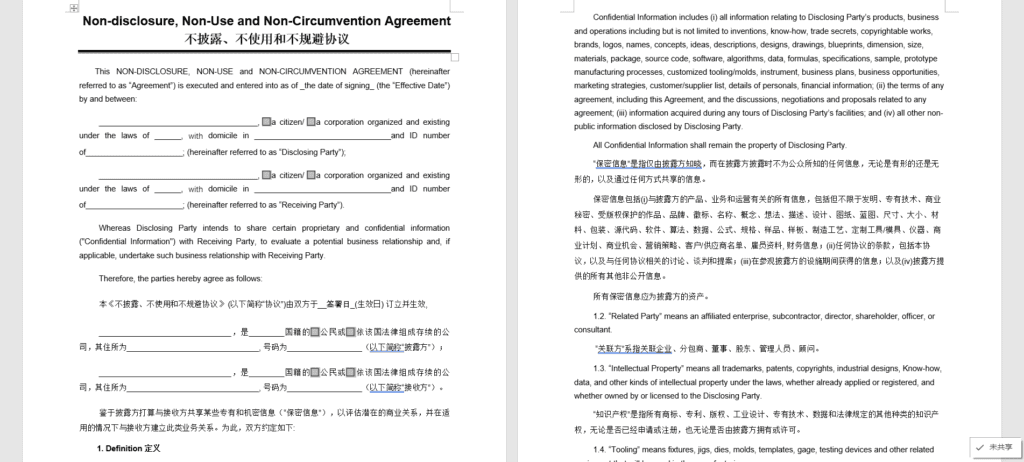
This guide explains what a China NNN agreement is, why ordinary NDAs often fail in China, and how to structure an enforceable agreement under Chinese law. Click here to download our old draft of the NNN agreement for your reference.
What Is an NNN Agreement?
An NNN Agreement is a legal agreement commonly used in China manufacturing transactions to protect foreign companies from intellectual property misuse by Chinese suppliers, factories, manufacturers, or sourcing companies.
“NNN” stands for:
- Non-Disclosure – The supplier cannot disclose your confidential information.
- Non-Use – The supplier cannot use your information for purposes outside your project.
- Non-Circumvention – The supplier cannot bypass you and sell directly to your customers or markets.
Unlike a traditional NDA, which only covers non-disclosure, an NNN agreement is specifically designed for the realities of manufacturing in China. It addresses the three most common ways Chinese suppliers misuse foreign companies’ intellectual property: sharing it, using it, and circumventing the buyer.
Common Mistakes When Signing an NNN Agreement
Many foreign companies simply download a U.S.-style NDA template and ask the Chinese factory to sign it. Unfortunately, this approach often provides little practical protection. Here are the 7 most common mistakes we see in our practice:
1. The Agreement Is Governed by Foreign Law or Foreign Jurisdiction
If the NDA is governed by U.S. or European law, enforcing it in China may become extremely difficult and expensive.
Even if you obtain a foreign court judgment, enforcing that judgment against a Chinese company in China can be challenging.
Solution: Specify PRC (Chinese) law as the governing law and choose a Chinese court or CIETAC (China International Economic and Trade Arbitration Commission) arbitration as the dispute resolution mechanism. This makes enforcement practical — Chinese courts can directly order remedies against the manufacturer’s assets.
2. Failing to Protect Product Development Results
Many foreign companies focus only on protecting confidential information, but overlook ownership and control of product development and improvements (like CAD drawings, STP files, prototypes, molds, testing data), created during cooperation with Chinese manufacturers.
If the agreement does not clearly specify ownership of these development results, disputes may arise regarding:
- product improvement ownership,
- 2D/ 3D files ownership,
- molds ownership.
Solution: Include a product development & molds clause that explicitly transfers all development results (drawings, prototypes, molds, improvements) to the foreign buyer unconditionly or upon payment. The agreement should state that all such materials are works made for hire and belong exclusively to you.
3. The Chinese Company Is Incorrectly Identified
Many foreign buyers sign agreements with:
- trading companies
- wrong Chinese company names,
- unofficial English company names,
- sales representatives,
- or Hong Kong affiliates,
instead of the actual mainland Chinese manufacturer.
If the wrong entity signs the agreement, enforcement may become impossible. The manufacturer can simply argue that they never signed any agreement with you, and the trading company that did sign may have no assets to pursue.
Solution: Verify the manufacturer’s official Chinese registered name via the National Enterprise Credit Information Publicity System (NECCIPS). Use this exact name — in Chinese characters — in the agreement. Never rely on an English trading name or a Hong Kong entity name when your actual manufacturer is a mainland Chinese company.
4. No Chinese Company Chop
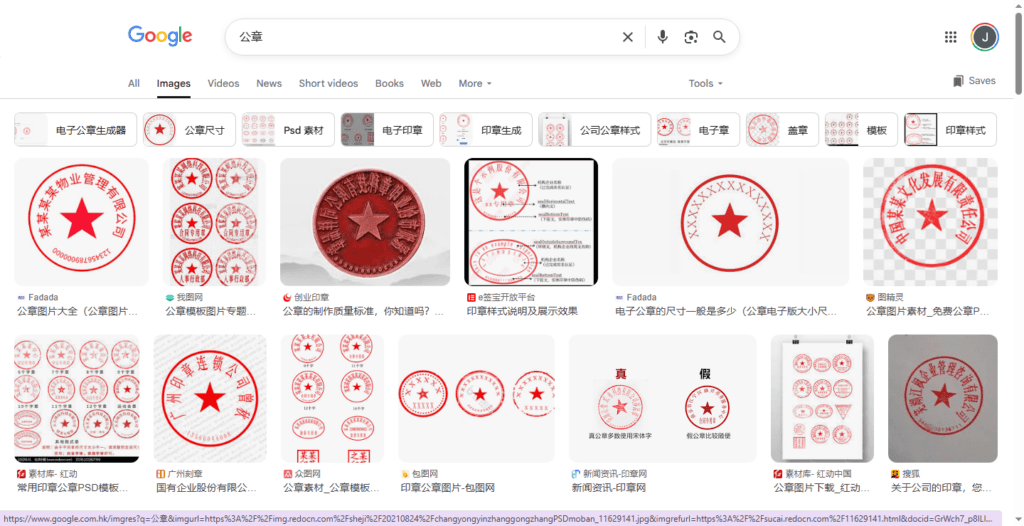
In China, the official company chop — a red circular seal (see below) registered with the Public Security Bureau — carries significant legal importance. An agreement signed only by an individual employee without the company chop, or with a private/unofficial chop, may later be disputed by the supplier as unauthorized.
The company chop is China’s equivalent of a corporate signature. It proves that the company itself — not just an individual employee — has committed to the agreement. Without it, the manufacturer can later claim the employee who signed had no authority to bind the company.
Solution: Always insist on the official registered company chop on each page. Verify that the chop matches the company’s registered name at the Public Security Bureau.
5. Sending Product Drawings Before Signing
Many buyers disclose sensitive technical drawings, specifications, and pricing during quotation discussions — before any agreement is executed. This creates a major risk: once the information is disclosed without a contract, there is legal base to prove misappropriation later.
Solution: Sign the NNN agreement BEFORE sharing any technical information, drawings, or specifications. For initial quotations, share only non-sensitive summary information. Provide detailed drawings only after the agreement is signed and chopped.
6. Failing to Verify the Supplier
Foreign companies should conduct basic due diligence on the Chinese manufacturer before signing any agreement, including:
- Business registration — verify the company exists, is active, and has the correct business scope
- Litigation history — check for prior IP disputes or contract breaches in Chinese court records
- Manufacturing capability — confirm they can actually produce your product to specification
- Debt situation — check financial health, as distressed companies are more likely to misuse IP
Solution: Conduct supplier verification through the National Enterprise Credit Information Publicity System (NECCIPS), China Judgements Online (for litigation history), or a qualified third-party due diligence service. The cost of a background check is negligible compared to the cost of IP theft.
7. No IP Registration in China
An NNN agreement alone may not be sufficient because it generally binds your contract party. Companies should also consider IP registration in China to protect against 3rd party:
- patents– protect inventions and technical solutions
- designs– protect product appearance and ornamental design
- copyright– protect software, artistic works, etc.
- trademarks– protect brand names and logos
Solution: file your IP before sharing any confidential information, even if you have a strong NNN.
Key Clauses in a China NNN Agreement
What clauses should be in a China NNN agreement? A properly drafted agreement should include the following essential provisions. Each clause addresses a specific risk in the China manufacturing context.
1. Confidential Information Definition
The agreement should clearly and specifically define what constitutes confidential information. Overly vague definitions weaken enforceability — the more specific you are, the easier it is to prove a breach in court.
The definition should cover:
- Technical drawings, CAD/STP files
- Prototypes and samples
- Tooling and molds
- Pricing and cost data
- Customer and supplier lists
- Product specifications
- Manufacturing methods and processes
- Business plans and strategies
- Any other non-public information disclosed during the relationship
2. Non-Use Restrictions
The manufacturer should be expressly prohibited from:
- Producing your products independently or for third parties
- Using your design or know-how for other customers
- Reverse engineering your products
- Competing with your business using your confidential information
- Registering your IP (trademarks, patents, domain names) in their own name
Without a robust non-use clause, a supplier could legally use your designs to produce products for other customers — as long as they don’t “disclose” your information, a standard NDA would not prevent this.
3. Non-Circumvention Clause
This provision prevents the factory from:
- Contacting your customers directly
- Bypassing your company to sell in your market
- Selling your products online (e.g., on Alibaba, Amazon, or other platforms)
- Establishing competing distribution channels
This is one of the most important distinctions between an NDA and an NNN agreement. Without a non-circumvention clause, a supplier can legally bypass you and sell your products directly to your own customers — and a standard NDA provides no protection against this.
4. Liquidated Damages Clause
Under Chinese law (PRC Civil Code, Articles 585–588), proving actual damages from IP theft can be extremely difficult. The burden is on the injured party to prove the exact amount of loss, which is often impossible when the damage is unauthorized use of intellectual property. Therefore, a reasonable liquidated damages clause (违约金) is critical in China NNN agreements.
A well-drafted liquidated damages provision can:
- Increase deterrence — the supplier knows the exact penalty in advance
- Simplify litigation — no need to prove actual losses, which is the hardest part of IP litigation
- Strengthen negotiation leverage — a demand letter referencing a specific penalty amount carries more weight
Important note: Chinese courts have discretion to adjust liquidated damages that are disproportionately high relative to actual losses. The amount should be reasonable but meaningful — typically tied to the value of the project or a per-breach amount (e.g., $50,000 per breach). An amount that is clearly punitive may be reduced by the court.
5. Chinese Jurisdiction Clause
The agreement should specify:
- PRC law as the governing law
- A Chinese court or arbitral tribunal with jurisdiction
This makes enforcement significantly more practical. Chinese courts can directly order remedies against the manufacturer’s assets — freezing bank accounts, seizing goods, and enforcing injunctions. Foreign judgments, by contrast, require a separate recognition proceeding that is frequently denied by Chinese courts.
Arbitration is often preferred over court litigation for international parties because:
- Proceedings can be conducted in English
- Arbitral awards are enforceable internationally under the New York Convention (China is a signatory)
- Power of attorney and evidence legalization are more convenient, faster, and cheaper than for court proceedings
- The process is confidential, which may be preferable for business disputes
6. Bilingual Language Clause
A bilingual agreement in English and Chinese is strongly recommended. While Chinese courts operate in Chinese, a bilingual version ensures both parties understand their obligations and reduces interpretation disputes. In CIETAC arbitration, English is acceptable and commonly used.
We recommend specifying which language version prevails in case of inconsistency:
- For court litigation: the Chinese version should prevail, as courts operate in Chinese
- For CIETAC arbitration: the English version can prevail, as English is accepted in arbitration
Specifying the prevailing language in advance eliminates a common source of dispute — without this clause, a disagreement over the meaning of a key term could derail enforcement entirely.
Steps to Execute an Effective NNN Agreement
- Information Gathering: Gather all necessary details about both parties, the project’s relevant products/ services, and your specific requirements, if any.
- Drafting and Revision: Create a tailored agreement that reflects the specific nature of your collaboration and revise it as needed.
- Due Diligence: Conduct a thorough background check on the manufacturer to assess their reliability and compliance history.
- Execution: Ensure that the agreement is properly signed by authorized representatives and sealed with the official company chop, to make it legally binding.
What if the factory refuses to sign? If a manufacturer refuses to sign a reasonable NNN agreement, this is a major red flag. Consider it a deal-breaker — a reputable manufacturer with nothing to hide will typically agree to a balanced NNN agreement. If they insist on modifications, please negotiate in good faith but do not remove core protections (non-use, non-circumvention, liquidated damages, Chinese jurisdiction).
Maintaining the Validity of Your NNN Agreement
Signing the NNN agreement is just the beginning. The agreement may become INVALID or UNENFORCEABLE over time if you do not maintain confidentiality actively:
When Your NNN Agreement May Lose Effectiveness
- Your design or product becomes publicly available (e.g., through patent publication, trade show display, or public marketing) — once information enters the public domain, it is no longer considered confidential and cannot be protected contractually.
- Third parties who are not bound by the agreement gain access to your IP — you cannot enforce contractual obligations against non-parties. If a subcontractor, the manufacturer’s affiliate, or a logistics provider handles your IP without signing a confidentiality undertaking, your NNN agreement cannot reach them.
- The confidential information enters the public domain through no fault of the supplier — confidentiality obligations typically do not extend to information that becomes public through independent means.
How to Maintain Protection Over Time
Register patents, designs, and trademarks in China — this provides legal recognition and protection beyond contract law. IP registration gives you statutory rights enforceable against anyone, not just parties to your contract.
Limit information disclosure — share only what is strictly necessary for production, or share different parts with independent factories.
Require all employees and subcontractors of the manufacturer to be bound by confidentiality obligations — extend the NNN to cover subsidiaries, affiliates, and subcontractors.
FAQ
Yes, properly drafted NNN agreements governed by Chinese law can generally be enforceable against Chinese manufacturers.
However, enforceability depends heavily on:
drafting quality,
jurisdiction,
language,
execution formalities,
and evidence.
Yes. In most cases, the company chop is a crucial element of effectiveness in China.
For disputes involving Chinese manufacturers and are submitted to a Chinese court, Chinese law is often the most practical choice.
Usually not, because of 3rd parities without blinding contracts. Businesses should also consider trademark registration, patents, manufacturing agreements, and supply chain controls.
Please do not hesitate to reach out to us if you are preparing to draft or sign an NNN agreement with Chinese manufacturers. We can draft a customized, enforceable agreement tailored to your specific industry, product, and risk profile — or review your existing agreement for enforceability gaps.