Last updated: 2026-09-16
Key Takeaways
- China uses a first-to-file system: the first applicant to file a mark with CNIPA generally obtains exclusive rights, making early filing critical.
- Registration takes approximately 12 months: 9 months for CNIPA examination + 3 months for publication and opposition.
- Official fees are RMB 300 per class (up to 10 items), with RMB 30 per additional item; renewal is RMB 500 per class every 10 years.
- Foreign applicants must use a registered Chinese trademark agency or file via the Madrid System territorial extension.
- Trademarks can be invalidated or cancelled: invalidation within 5 years on specific grounds; cancellation if unused for 3 consecutive years.
- Six trademark types are recognized: word marks, figurative marks, combination marks, color combinations, sound marks, and 3D marks.
China is the world’s largest trademark filing market, with the China National Intellectual Property Administration (CNIPA) receiving over 934,000 trademark applications in 2023 alone—more than any other country. China’s trademark system operates on a first-to-file principle, meaning the first person to file a mark generally obtains the exclusive rights, regardless of who used it first. This makes early registration critical for any brand entering the Chinese market. This guide covers everything you need to know: trademark types, filing routes, costs, required documents, the CNIPA examination process, refusal reasons, opposition, invalidation, cancellation, and practical tips to maximize your chances of successful registration.
Types of Trademarks in China
China’s trademark system, administered by the China National Intellectual Property Administration (CNIPA), recognizes six types of trademarks. Each type protects a different aspect of brand identity:
| Trademark Type | Description | Example |
|---|---|---|
| Word Marks | Letters, numbers, words, or combinations thereof | “Apple”, “IBM”, “7-Eleven” |
| Figurative Marks | Logos, symbols, or graphical design elements | Nike swoosh, McDonald’s golden arches |
| Combination Marks | A combination of words and graphics | Coca-Cola logo with stylized text |
| Color Combinations | Specific arrangements of colors that distinguish a brand | UPS brown and gold color scheme |
| Sound Marks | Unique sounds associated with a brand | MGM lion roar, Intel audio logo |
| 3D Marks | Distinctive three-dimensional shapes or packaging | Coca-Cola bottle shape, Toblerone packaging |
Regardless of type, all trademarks must meet the distinctiveness requirement under the Chinese Trademark Law—they must be capable of distinguishing the goods or services of one entity from those of others.
Filing Routes: Domestic Filing vs. Madrid System
Applicants have two main routes for filing trademark applications in China. The choice depends on the applicant’s nationality, the number of countries where protection is sought, and strategic considerations:
| Factor | Domestic Filing (Direct) | Madrid System (Territorial Extension) |
|---|---|---|
| Who can use | Chinese nationals/entities; foreign applicants via Chinese agency | Applicants from Madrid Protocol member countries |
| Best for | Single-country filing (China only) | Multi-country protection (3+ countries including China) |
| Priority claim | Yes, within 6 months of first Paris Convention filing | International priority based on home application |
| Processing time | ~12 months (9 months exam + 3 months publication) | ~18 months (WIPO processing + CNIPA examination) |
| Language | Chinese | English, French, or Spanish (translated by WIPO) |
| Cost efficiency | Lower for single-country filing | Lower for multi-country filing (one application) |
Paris Convention priority: If you have filed a trademark application in another Paris Convention member country, you can claim priority in China within 6 months of the original filing date. This means your Chinese application will be treated as if filed on the same date as your original application, giving you priority over later filers.
Costs of Trademark Registration in China
Understanding the costs involved helps businesses budget effectively. The total cost includes government fees and professional service fees:
| Fee Category | Amount (CNY) | Details |
|---|---|---|
| Government filing fee | 300 per class | Covers up to 10 items (goods/services) per class |
| Additional items | 30 per item | For items beyond the first 10 in a class |
| Renewal fee | 500 per class | Payable every 10 years |
| Opposition filing fee | 500 per class | If filing or defending against an opposition |
| Re-examination fee | 500 per class | If requesting re-examination after refusal |
| Professional/agency fees | Varies | Charged by trademark attorneys or agencies |
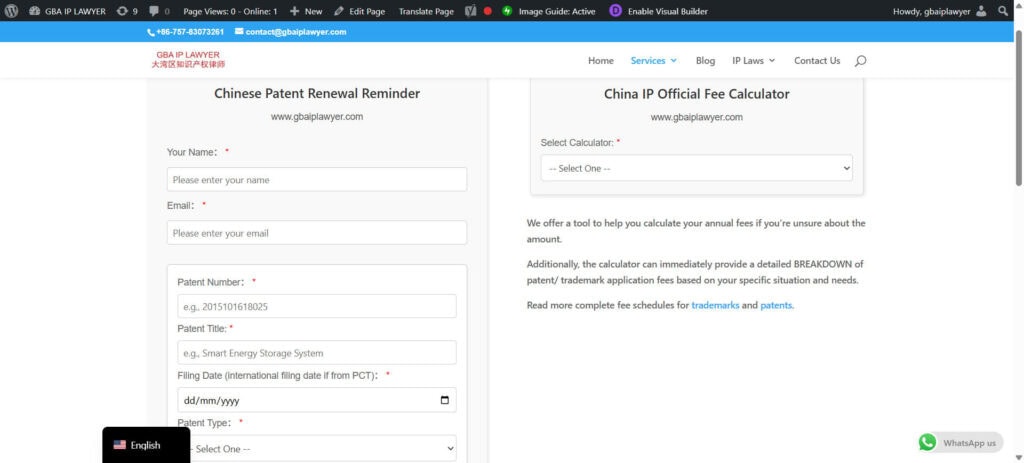
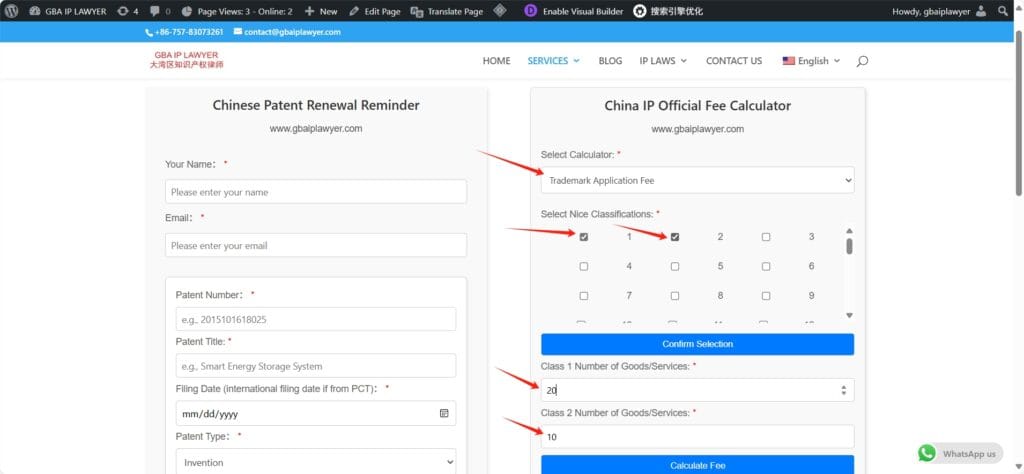
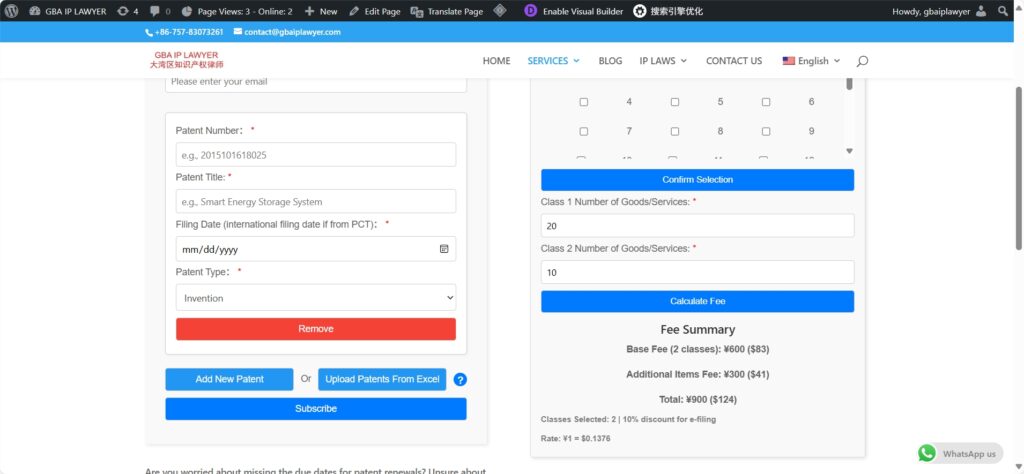
For a detailed breakdown of costs, read more about Chinese trademark application fees, or use our trademark fee calculator (see more below) to evaluate your application costs in advance.
You can verify your trademark firm’s registration with CNIPA here.
Required Documents Checklist
Prepare the following documents before starting the trademark application process to avoid delays:
| Document | Required For | Notes |
|---|---|---|
| Identity documents of applicant | All applications | Individuals: passport/ID; Companies: business license/certificate of incorporation |
| Trademark sample | All applications | Clear image of the mark (JPG format, 5-10cm, 300dpi) |
| List of goods/services | All applications | Classified according to Nice Classification (1-45 classes) |
| Power of Attorney (POA) | Foreign applicants & agency filings | Signed by the applicant; download POA template |
| Priority documents | Paris Convention priority claims | Certified copy of the original application; filed within 3 months of Chinese filing |
| Instructions for trademark registration | Agency filings | Download instructions template |
Trademark Registration Process Step by Step
The complete trademark registration process in China typically takes approximately 12 months from filing to certificate issuance. Here is the step-by-step breakdown:
| Stage | Timeline | What Happens |
|---|---|---|
| Pre-filing search & filing | ~10 days | Conduct trademark search, prepare documents, and submit application to CNIPA |
| Formal & substantive examination | ~9 months | CNIPA reviews the application for formalities, distinctiveness, and conflicts |
| Publication & opposition period | 3 months | Approved mark is published for public opposition |
| Registration & certificate | ~12 months total | If no opposition (or opposition resolved), trademark is registered and certificate issued |
Step 1: Pre-filing Trademark Search
Before filing, search CNIPA’s trademark database at sbj.cnipa.gov.cn to identify any conflicting or similar marks. This is the most critical step to reduce the risk of rejection or opposition.
A comprehensive search should check:
- Identical marks in the same class
- Phonetically similar marks (e.g., “Koka” vs. “Coca”)
- Visually similar logos or figurative elements
- Chinese translations or transliterations of foreign brand names
- Marks across multiple Nice Classification classes (cross-class protection for well-known marks)
CNIPA also offers an AI-powered image search function for figurative marks. We strongly recommend engaging a Chinese trademark attorney for professional search analysis.
Step 2: Filing the Application
Submit the application to CNIPA along with all required documents (see Required Documents Checklist above). Key filing requirements:
- Foreign applicants: Must file through a registered Chinese trademark agency—direct filing is not permitted for applicants without a Chinese domicile or business presence
- Chinese applicants: Can file directly through CNIPA’s online system
- Madidas System applicants: Can designate China as a territorial extension in their international application via WIPO
- Priority claim: If claiming Paris Convention priority, submit priority documents within 3 months of the Chinese filing date
Filing typically takes about 10 days to process and receive a filing receipt with an application number.
Step 3: CNIPA Formal and Substantive Examination
CNIPA examines each application in two phases:
- Formal examination: Checks that all required documents are submitted, fees are paid, and the application meets basic formatting requirements.
- Substantive examination: Reviews the mark for distinctiveness, absolute grounds for refusal (see Common Reasons for Refusal), and conflicts with existing registered or pending trademarks.
This examination phase takes approximately 9 months. If the examiner identifies issues, a refusal notice (Office Action) is issued, and the applicant has 15 days to respond or request re-examination.
If the applicant disagrees with the refusal decision, they can request a re-examination by CNIPA. The re-examination process typically takes another 9 months (Art. 34 of the Trademark Law). Read more about calculating re-examination deadlines.
Step 4: Publication and Registration
Applications that pass examination are published in the CNIPA Trademark Gazette for a 3-month opposition period. During this window:
- Any interested party may file an opposition (see Trademark Opposition below)
- If no opposition is filed, the trademark proceeds to registration
- If opposition is filed but resolved in the applicant’s favor, the trademark is registered
Upon successful registration, CNIPA issues a Trademark Registration Certificate, and the mark is recorded in the Trademark Register. The registration is valid for 10 years from the registration date and can be renewed indefinitely.
Common Reasons for Trademark Refusal
Trademark applications in China may be refused on either relative grounds (conflicts with third-party rights) or absolute grounds (inherent defects in the mark itself).
Relative Grounds for Refusal
These involve conflicts with existing rights of third parties:
- Similarity to existing marks: The proposed mark is deemed confusingly similar to an existing registered or pending trademark in the same or related class (e.g., “Starbake” vs. “Starbucks”).
- Cross-class protection for well-known marks: Using a well-known mark in a different class (e.g., using “Coca-Cola” for clothing when it is already famous for beverages).
- Infringement of prior rights: Unauthorized use of a third party’s copyright, design, portrait, or name (e.g., using Yao Ming’s name without authorization).
- Bad faith filing: Applications submitted with malicious intent, including:
- Trademark squatting: Registering a foreign brand not yet registered in China
- Hoarding: Registering trademarks solely for resale without intent to use
Absolute Grounds for Refusal
These involve inherent defects in the mark itself, independent of any third-party rights:
- Lack of distinctiveness: The mark is too generic (e.g., “Aspirin” for medicine) or merely descriptive (e.g., “Sweet” for cakes) and fails to distinguish the goods or services.
- Negative social impact: Marks containing offensive or socially harmful terms (e.g., “Gangster,” “Thug”).
- Misleading terms: Marks that deceive consumers (e.g., “Organic” used without certification for fruits).
- Religious or cultural insensitivity: Direct use of religious symbols (e.g., Buddha statues, crosses) without proper authorization.
- Use of national symbols: National flags, emblems, or names of international organizations without authorization.
Re-Examination Process
Applicants facing a refusal can request CNIPA to re-examine the decision. The re-examination process:
- Must be filed within 15 days of receiving the refusal notice
- Takes approximately 9 months for CNIPA to issue a re-examination decision (Art. 34)
- If re-examination is also refused, the applicant can file an administrative lawsuit with the Beijing Intellectual Property Court
Trademark Opposition in China
After CNIPA approves an application, it is published for a 3-month opposition period. During this window, any interested party can file an opposition to prevent the mark from being registered.
Grounds for Opposition
Opposition can be filed on the following grounds under the Chinese Trademark Law:
- Article 30: Similarity to earlier registered or published trademarks
- Article 31: Similarity to earlier applied (pending) trademarks
- Article 32: Infringement of prior rights (designs, copyrights, portraits) or unauthorized use of another party’s existing mark
- Article 15: Squatting by a party with a prior relationship (agent, distributor, business partner)
For more details, read the full text of the Chinese Trademark Law.
Responding to Opposition
If your application faces an opposition, you must respond within 30 days by submitting evidence and counterarguments to CNIPA. Effective responses typically include:
- Evidence of prior use and market presence
- Proof of distinctiveness and consumer recognition
- Arguments distinguishing the mark from the opponent’s mark
- Evidence of bad faith by the opponent (if applicable)
Duration of Opposition
The opposition process typically takes 12 months from the publication date (Art. 35). If the opposition is unsuccessful, the trademark proceeds to registration. If the opposition succeeds, the application is refused, and the applicant can appeal.
Invalidation of Trademarks
Even after a trademark is registered, third parties or CNIPA can initiate invalidation proceedings to have the registration declared invalid. Invalidation can be requested on the same grounds as opposition, but it applies to already-registered trademarks.
Key Rules for Invalidation
- Time limit: Invalidation is best requested within 5 years from the registration date. For well-known marks or bad faith filings, there is no time limit.
- Grounds: Similarity to prior marks, lack of distinctiveness, absolute grounds (misleading, negative social impact), or bad faith filing.
- Duration: The invalidation process typically takes 12 months from the request date (Art. 45).
- Effect: If invalidated, the trademark is deemed never to have been registered (retroactive effect).
Cancellation of Trademarks
Separate from invalidation, cancellation (also called non-use cancellation) can be requested by anyone if a registered trademark has not been used in China for 3 consecutive years from the date of registration.
Key Rules for Cancellation
- Ground: Non-use for 3 consecutive years (Art. 49). The trademark owner bears the burden of proving use.
- Acceptable evidence of use: Sales contracts, invoices, advertising materials, product packaging, exhibition materials showing the mark is used in commerce in China.
- Duration: The cancellation process typically takes 9 months from the request date (Art. 49).
- Re-examination: Either party can request re-examination of the cancellation decision, which takes another 9 months (Art. 54).
Important distinction: Invalidation challenges the validity of the trademark itself (it should never have been registered). Cancellation challenges the ongoing use of a validly registered trademark (it was registered but has been abandoned).
Pro Tips for Successful Trademark Registration
- File early—before entering the Chinese market. China’s first-to-file system means trademark squatting is a real threat. File before launching products, attending trade shows, or even announcing your China plans.
- Register both your English name and its Chinese transliteration. Foreign brands are especially vulnerable to squatters who register the Chinese version of the name. Consider registering both the original mark and its Chinese equivalent.
- Conduct a comprehensive pre-filing search. Check not only identical marks but also phonetic and visual similarities, Chinese transliterations, and marks across multiple Nice Classification classes.
- File in all relevant classes. China follows the Nice Classification system (45 classes). File in all classes relevant to your current and future business to prevent competitors from registering your mark in other classes.
- Keep evidence of use. If your trademark faces a non-use cancellation action, you will need to prove use in China. Maintain records of sales, advertising, exhibition participation, and product packaging.
- Monitor the Trademark Gazette. Regularly check CNIPA’s publications for marks that conflict with yours, and file oppositions within the 3-month window.
- Consider the Madrid System for multi-country protection. If you need protection in 3 or more countries including China, a single international application through WIPO can be more cost-effective.
- Work with an experienced Chinese trademark attorney. Navigating CNIPA’s procedures, responding to office actions, and managing oppositions require deep knowledge of Chinese trademark law and practice.
- Renew on time. Trademark registrations are valid for 10 years and must be renewed within 12 months before expiry (6-month grace period available). Set reminders to avoid lapse.
- Record licensing and assignments. If you license or transfer your trademark, record the change with CNIPA to maintain legal enforceability in China.
Frequently Asked Questions
Trademark registration in China typically takes 12 months from filing to certificate issuance. This includes approximately 9 months for CNIPA examination and 3 months for the publication and opposition period. If opposition is filed or re-examination is requested, the process can extend by 9-12 additional months.
No. Foreign applicants (individuals and entities without a domicile or business presence in China) must file through a registered Chinese trademark agency authorized by CNIPA. Chinese nationals and entities with a presence in China can file directly. Foreign applicants can also use the Madrid System to designate China as a territorial extension in their international application.
CNIPA charges RMB 300 per class for up to 10 items (goods/services). Each additional item beyond 10 costs RMB 30. Renewal fees are RMB 500 per class, payable every 10 years. Professional fees charged by trademark agencies vary depending on the service provider and complexity of the application.
China uses a first-to-file system, meaning the first applicant to file a mark with CNIPA generally obtains exclusive rights. This is different from first-to-use systems like the United States. This makes early filing critical—delaying registration can result in trademark squatting, where another party registers your brand name before you do.
The Madrid System is an international trademark filing mechanism administered by WIPO. If your home country is a member of the Madrid Protocol, you can designate China as a territorial extension in your international application. This is more efficient if you seek protection in 3 or more countries including China.
Yes. After CNIPA approves an application, it is published for a 3-month opposition period. Any interested party can file an opposition on grounds such as similarity to earlier marks, infringement of prior rights (design, copyright), or bad faith filing (e.g., squatting). The opposition process typically takes 12 months from the publication date.
If your application is refused, you can request a re-examination by CNIPA within 15 days of receiving the refusal notice. The re-examination process typically takes 9 months. You should address the examiner’s specific objections and provide arguments or evidence. If re-examination is also refused, you can file an administrative lawsuit with the Beijing Intellectual Property Court.
Yes. A registered trademark can be invalidated by third parties on grounds similar to opposition (similarity, lack of distinctiveness, bad faith), preferably within 5 years of registration. Additionally, anyone can request cancellation if the trademark has not been used in China for 3 consecutive years. Invalidation typically takes 12 months; cancellation takes approximately 9 months.
You can search CNIPA’s trademark database at sbj.cnipa.gov.cn. CNIPA also offers an AI-powered image search function for figurative marks. A comprehensive pre-filing search should check identical marks, phonetic similarities, and visually similar logos across all relevant Nice Classification classes. We strongly recommend working with a Chinese trademark attorney for professional search analysis.
A registered trademark in China is valid for 10 years from the date of registration. It can be renewed indefinitely for subsequent 10-year periods by paying a renewal fee of RMB 500 per class. The renewal application should be filed within 12 months before the expiry date, with a 6-month grace period available.
References and Further Reading
- China National Intellectual Property Administration (CNIPA) — Official Website
- WIPO — Madrid System
- Chinese Trademark Law — Full Text
- Chinese Trademark Application Fees — Detailed Breakdown
- Trademark Fee Calculator
- CNIPA AI-Powered Image Search for Trademark Searches
- Calculating Trademark Rejection Review Deadlines in China
Our experienced IP attorneys handle the entire trademark registration process—from pre-filing search to application filing, opposition defense, and renewal management. We serve international clients worldwide.