
Last updated: 2026-10-04
China Customs IP protection lets you stop counterfeit and infringing goods at the border — before they reach a buyer, a port, or a container ship. To do it, you record your trademark, patent or copyright with the General Administration of Customs of China (GACC). Once recorded, Customs monitors imports and exports on your behalf, detains suspect shipments, and can конфисковать the goods and fine the shipper up to 30% of the goods’ value.
This guide explains what can be recorded, the two enforcement routes, the exact documents, bond amounts and deadlines, and what it costs — with references to the governing regulations and the latest official enforcement data.
Основные выводы
- Recording is free. GACC has charged no IP recordal fee since 1 January 2015; the official decision takes 30 рабочих дней from receipt of a complete file.
- Protection lasts 10 years from approval (or the remaining life of your IP, if shorter). Renew within the 6 месяцев before expiry.
- Only three rights qualify: goods trademarks (not service marks), patents (invention / utility model / design), and copyright. Trade secrets, GIs, IC layouts and plant varieties do not.
- Proactive (ex officio) protection requires recordal, costs a modest bond (capped at RMB 100,000), and lets Customs investigate and punish.
- Passive (upon-application) protection needs no recordal but requires a bond equal to the full value of the goods, and Customs will release the shipment after 20 рабочих дней unless a court steps in.
- Speed matters: once Customs notifies you, you have only 3 рабочих дня to file a detention application and post bond.
- Foreign rights holders must act through a mainland China agent holding a power of attorney.
What Is China Customs IP Protection?
China Customs IP protection (知识产权海关保护) is the system under which the General Administration of Customs detains, investigates, confiscates and penalizes imported or exported goods that infringe intellectual property rights protected under Chinese law. Its legal basis is the Таможенное право Китая and, in detail, the Regulations on Customs Protection of Intellectual Property Rights (State Council Decree No. 395, as amended in 2010 and 2018) together with GACC Decree No. 183 (the “Implementing Measures”, amended 2018).
The operational centre of the system is IP recordal (知识产权海关保护备案): filing your right with GACC so that Customs can act on it. Recordal is what converts your IP from a private right into a border-enforcement trigger.
Why it is worth doing. Customs is often the cheapest enforcement channel in China: you do not need to identify a defendant in advance, Customs screens shipments on its own initiative, and the counterfeiter bears the loss of an entire shipment. In 2025, China Customs detained 38,700 batches / 86.42 million items of suspected infringing goods, and rights holders from 57 countries and regions used the system; GACC approved 35,200 IP recordals that year — an all-time high (GACC press conference, 23 April 2026).
What IP Can Be Recorded with China Customs?
Only the rights listed in Article 2 of the Regulations qualify. The table below is the practical answer most rights holders search for.
| Intellectual property | Recordable? | Practical notes |
|---|---|---|
| Registered trademark (goods) | Да | Service marks are excluded — Customs only protects marks used on goods. One application per international registration class. |
| Patent — invention | Да | Patent certificate required. If more than 1 year has passed since grant announcement, also a patent register extract issued within the previous 6 months. |
| Patent — utility model / design | Да | Additionally requires a отчет об оценке патента from CNIPA, plus patent announcement drawings. |
| Copyright and related rights | Да | Voluntary copyright registration certificate, or work samples plus other proof of authorship, with certified work photos. |
| Trade secrets | Нет | Protect instead by contract and the Anti-Unfair Competition Law — see our guide to protecting trade secrets in China. |
| Geographical indications | Нет | Enforce via trademark (collective/certification marks), administrative complaint or civil action instead. |
| Integrated circuit layout designs | Нет | Not within Article 2. |
| New plant varieties | Нет | Not within Article 2. |
| Unregistered / pending marks | Practically no | A Chinese registration is needed first — start with регистрация товарного знака в Китае. |
The Two Routes: Proactive vs. Passive Protection
Chinese law gives you two distinct mechanisms. Choosing correctly is the single biggest decision in your enforcement strategy.
| Proactive protection (依职权, ex officio) | Passive protection (依申请, upon application) | |
|---|---|---|
| Prior recordal with GACC | Required | Не требуется |
| Who initiates | Customs screens shipments and notifies you | You file first, with evidence of a specific shipment |
| Your response window | 3 рабочих дня from Customs notice | You must act before the goods clear |
| Bond / guarantee | Tiered, capped at RMB 100,000 (see table below) | Equal to the full value of the goods |
| Customs investigation | Да — Customs determines infringement itself | Нет — Customs only detains; a court must decide |
| Release if no court order | After 50 рабочих дней from detention | After 20 рабочих дней from detention |
| Outcome | Confiscation + administrative fine up to 30% of goods value | Goods handed to court proceedings you must start yourself |
| Идеально подходит для | Ongoing brand protection, high-volume counterfeiting | One-off known shipment, or IP not yet recorded |
Bottom line: proactive protection is far more effective and far cheaper per case, but it only works if you recorded your IP before the shipment appears. That is why recordal should be treated as routine IP housekeeping, not a reaction to a problem.
Proactive Protection: The 4-Step Process
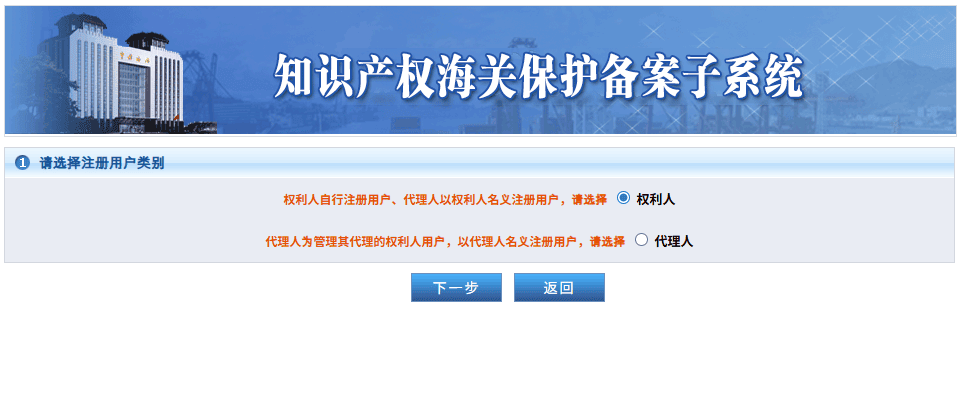
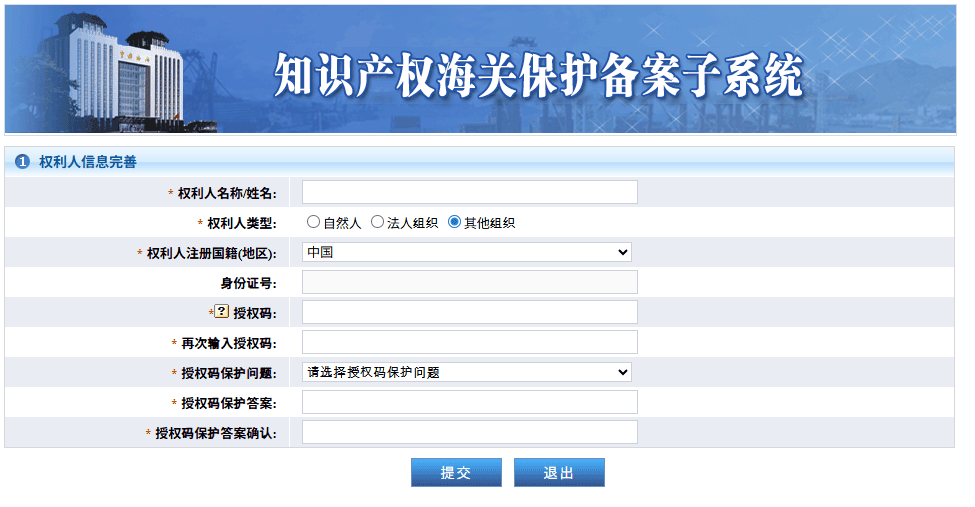
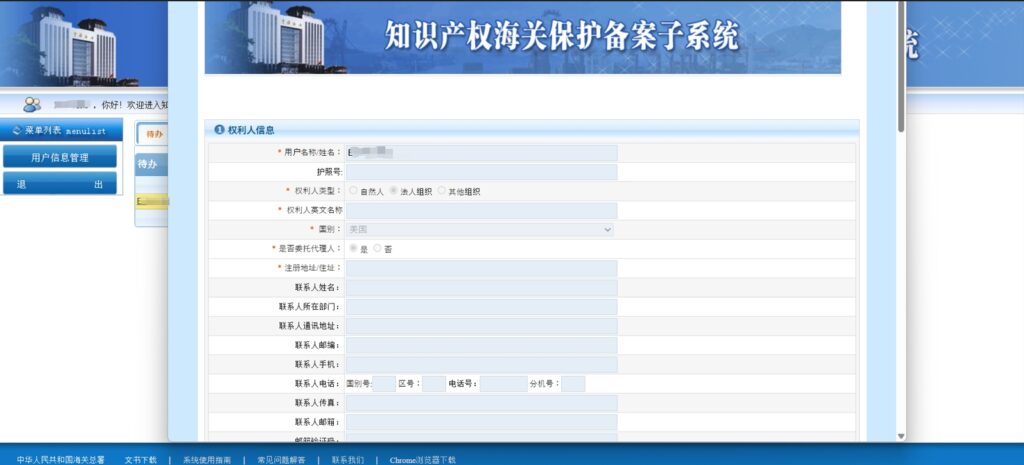
Step 1 — Record Your IP Rights with GACC
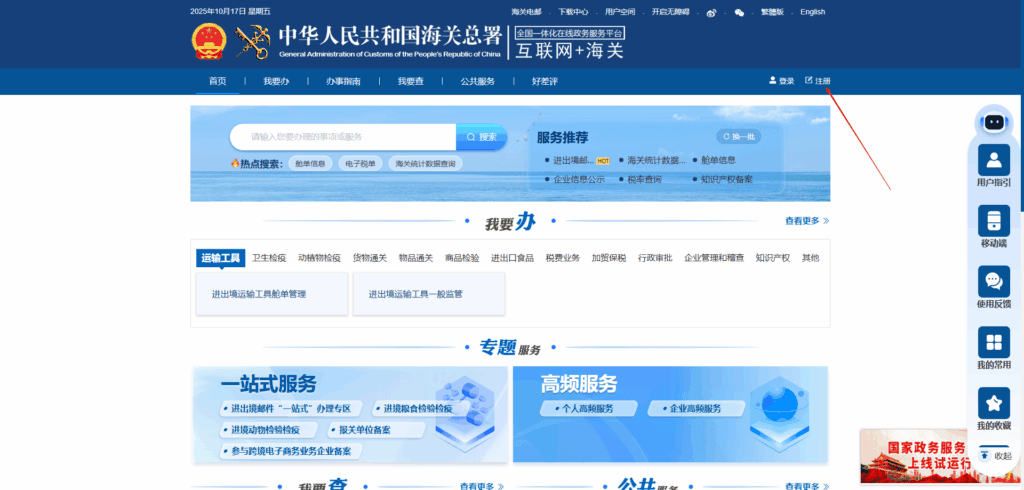
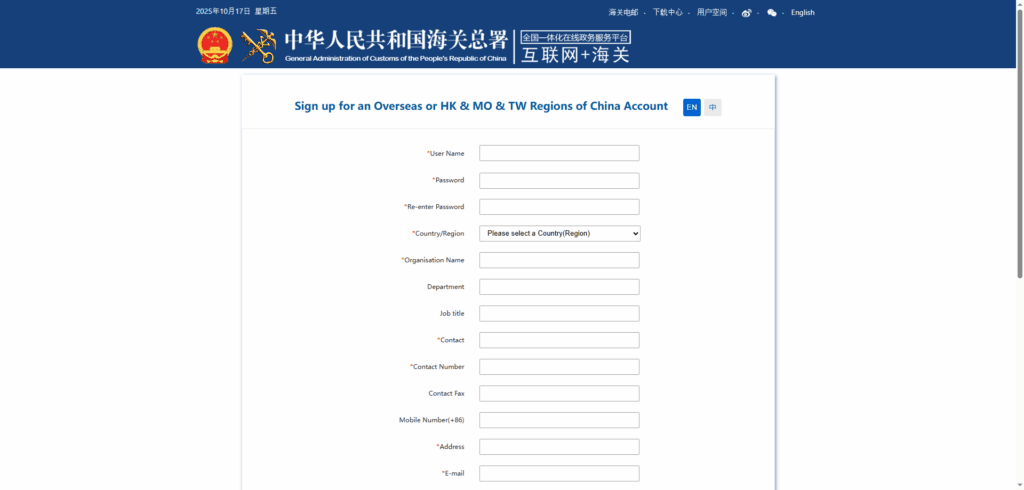
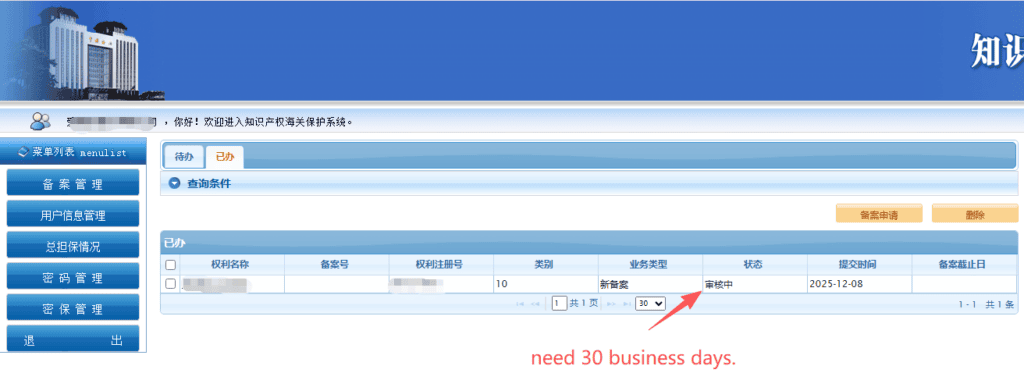
Where to file. Online, through the GACC Online Government Service Platform (online.customs.gov.cn), in the “Intellectual Property” section. The service is listed as free of charge, fully online, with a statutory and committed completion time of 30 рабочих дней (official service guide).
Documents you will need (per Article 7 of the Implementing Measures):
- Identity proof of the IP holder (company registration or passport).
- If you have no establishment in China: a power of attorney for a mainland agent. You can download our POA template.
- The IP certificate: trademark registration certificate, patent certificate, or copyright registration certificate.
- For patents granted more than one year ago: a certified Copy of the Patent Register is additionally required;
- For utility models and designs: a отчет об оценке патента is additionally required;
- For copyright: certified photos of the work are additionally required.
- Photos of genuine goods and packaging — and of known counterfeits, if you have them. These drive Customs’ AI image screening, so quality matters more than quantity.
- Available evidence of infringing goods and their manufacturers, importers, ports and prices.
Validity and renewal. A recordal takes effect on the date GACC approves it and lasts 10 лет — or the remaining term of your IP, if shorter. Apply for renewal within the 6 months before expiry; GACC decides on renewal within 10 working days, and each renewal runs another 10 years. If your right changes (assignment, licence, name change), file a change within 30 рабочих дней.





Step 2 — Customs Monitors and Notifies You
Once your recordal is live, Customs applies risk screening — including AI image recognition — to import and export declarations. If a shipment matches your recorded right and the trader is not a recorded licensee, Customs suspends release and notifies you in writing.
You then have 3 working days from receipt of that notice to reply. You must either file a detention application with bond, or explain in writing why the goods are not infringing. Silence is treated as a waiver — the goods ship.
You can also feed Customs your own intelligence: known counterfeit factories, rogue traders, ports, typical prices and transport routes. All of this belongs in the recordal file itself.
Step 3 — File the Detention Application and Post Bond
Under Article 23 of the Implementing Measures, the bond for proactive protection is not a flat RMB 100,000 — it is tiered by goods value:
| Value of the goods (RMB) | Bond required |
|---|---|
| Below 20,000 | 100% of the goods’ value |
| 20,000 – 200,000 | 50% of the goods’ value, minimum RMB 20,000 |
| Above 200,000 | RMB 100,000 (flat) |
Tip for frequent enforcers: the general guarantee (总担保). If your trademark is recorded, you can post a bank or financial-institution guarantee with GACC instead of paying case by case. The amount equals your previous year’s storage, handling and disposal costs, with a floor of RMB 200,000. Once approved, no further bond is needed for detentions that calendar year. For brands facing repeated seizures this is usually the cheapest option.
Also request photos of the detained goods for verification — and inspect the goods in person where Customs allows it. A wrong call exposes you to liability for wrongful detention.
Step 4 — Investigation, Confiscation and Penalty
After detention, Customs investigates and must determine infringement within 30 рабочих дней. If it cannot decide, it notifies you immediately and you must go to court:
- Infringement confirmed → Customs confiscates the goods and imposes an administrative fine of up to 30% of the goods’ value on the consignee or consignor, under Article 25 of the Implementing Regulations on Administrative Penalties of Customs. Confiscated goods go to charity, are sold back to you, or — usually — destroyed. Counterfeit branded goods cannot simply be de-branded and released into commerce.
- Infringement not determined → you must obtain a court order (injunction or property preservation) within 50 working days of detention, otherwise Customs releases the shipment.
- Criminal threshold → Customs refers the case to public security authorities. See the IP crimes section of China’s Criminal Law.
Patent owners, note: a consignee accused of patent infringement can post a counter-bond equal to the goods’ value and demand release. You then have 30 рабочих дней from Customs’ notice to file a court case and submit proof of acceptance. Patents are therefore the weakest right at the border in practice.
Passive Protection: When to Use It Instead
If you have not recorded your IP, or you learn of a specific imminent shipment, you can still apply to the customs office at the port of entry or exit. The conditions are stricter:
- You must submit evidence showing that infringement is obviously present — that the goods are about to be imported or exported, and that your mark, work or patent has been used without permission.
- You must provide the consignee and consignor, goods description and specification, and the likely port, timing and transport.
- You must post a bond equal to the full value of the goods.
- Customs detains but does not investigate. Unless a court sends an assistance notice within 20 рабочих дней, the goods are released.
Passive protection is best treated as an emergency brake, not a strategy.
China Customs IP Protection Timeline at a Glance
| Event | Крайний срок |
|---|---|
| GACC decision on recordal | 30 working days from complete application |
| GACC decision on renewal | 10 working days |
| Recordal validity | 10 years (or the remaining term of the IP) |
| Rights holder’s detention request (proactive) | 3 working days from Customs notice |
| Customs investigation and determination | 30 working days from detention |
| Release if undetermined and no court order (proactive) | 50 working days from detention |
| Release if no court order (passive) | 20 working days from detention |
| Patent counter-bond: rights holder files court action | 30 working days from Customs notice |
What Does China Customs IP Protection Cost?
- Government fees: none. GACC has not charged an IP recordal fee since 1 January 2015; renewal and change filings are also free.
- Agent fees: foreign rights holders must appoint a mainland agent. Budget for the POA, Chinese translations and filing handling.
- Bond: from a few thousand RMB up to RMB 100,000 per detention on the proactive route; the full goods value on the passive route. Bonds are refunded unless they are used to cover storage, handling, disposal or wrongful-detention compensation.
- Storage, handling and disposal costs: payable by the rights holder, deductible from the bond. If goods are confiscated, these costs can be claimed as reasonable enforcement expenses in later damages claims.
Five Mistakes That Cost Rights Holders Their Seizure
- Recording too late. Recordal takes 30 working days. Do it when you register the IP in China, not when you discover the counterfeits.
- Poor photo evidence. Customs’ first filter is now image-based. Blurry or missing genuine-vs-counterfeit photos are the most common cause of missed detections.
- Missing the 3-day window. Build an internal alert process: monitor the registered mailbox and pre-authorise your agent to act.
- Recording only the parent mark. Record the marks actually used on goods, in each relevant class, including Chinese-character versions and logos.
- Letting the recordal lapse. Track expiry: renewal is only possible in the 6 months before the 10-year term ends, and a lapsed recordal silently disables proactive protection.
Часто задаваемые вопросы
Yes. GACC stopped charging the IP recordal fee on 1 January 2015, and the official service guide states the procedure is not charged. Renewals and changes are free as well. You still pay for your Chinese agent, translations and — when you detain goods — the bond and storage costs.
GACC must decide within 30 рабочих дней of receiving a complete application, and this is both the statutory and the committed time limit. Renewal decisions take 10 working days. In practice, incomplete documents — most often a missing patent evaluation report or Chinese translation — are what delay filings.
10 лет from the date GACC approves it, or the remaining term of your IP if that is shorter (for example a trademark with 4 years left is recorded for 4 years). Apply to renew within the 6 months before expiry; each renewal runs a further 10 years.
Yes, if you have no establishment in China. Article 2 of the Implementing Measures requires overseas rights holders to file through a mainland office or a commissioned mainland agent, with a power of attorney in the prescribed form. Domestic rights holders may file directly or through an agent.
No. Article 2 of the Regulations covers only trademark rights in goods, copyright and related rights, and patents. Service marks, trade secrets, geographical indications, integrated circuit layout designs and new plant varieties fall outside the system. Brands often protect GIs indirectly through collective or certification marks.
On the proactive route: 100% of goods value below RMB 20,000; 50% (minimum RMB 20,000) between RMB 20,000 and 200,000; and a flat RMB 100,000 above RMB 200,000. On the passive route, a bond equal to the full value of the goods. Trademark owners who recorded their mark can use a general guarantee instead — a bank guarantee with a RMB 200,000 floor, valid for the rest of the calendar year.
Usually not. GACC does not routinely require notarization of identity proof, POA or translations. However, if Customs doubts the authenticity of a document it may demand notarization or authentication, and all foreign-language documents must be accompanied by a Chinese translation. Certified copies should be marked “verified against the original” and sealed.
You must apply to a Chinese court for an injunction or property preservation order. On the proactive route Customs releases the goods after 50 рабочих дней from detention without a court assistance notice; on the passive route, after 20 рабочих дней.
Apply to the court to collect evidence. The customs declaration form (报关单) the shipper filed lists the consignee, the manufacturer, quantities, unit prices, and total value — evidence that drives both liability and the damages calculation.
You do. Article 25 makes the rights holder liable for storage, custody and disposal costs, and Customs may deduct them from your bond. If the goods are eventually found to be infringing, you can add those costs to your claim as reasonable expenses incurred in stopping the infringement.
Yes. The system applies to goods imported and exported by any trade mode, including post and express. Articles carried or mailed by individuals beyond reasonable personal use are also treated as infringing goods, and GACC has built specific risk models for cross-border e-commerce and market-procurement shipments.
Search the public GACC IP protection database. Chinese suppliers, distributors and licensees commonly use it to verify that a brand owner’s recordal is genuine and current before shipping.
Дополнительная информация
Customs recordal works best as part of a wider China IP program: register the underlying right first, record it at Customs, and pair it with supplier due diligence and platform takedowns.
- Trademark Registration in China: Complete Guide to Process & Costs
- Руководство по подаче патентной заявки в Китае
- Руководство по регистрации и защите авторских прав в Китае
- Как провести проверку надежности китайского поставщика
- Как заключить имеющий юридическую силу договор NNN с китайскими производителями
- Как удалить контрафакт с Alibaba
- Как отправить письмо о прекращении и отказе в связи с нарушением прав интеллектуальной собственности в Китае
- Официальное руководство по защите ИС от таможенных органов Китая
Contact us if you need to protect your IP against infringing importers and exporters at China Customs.