
Last updated: 2026-05-25
Introduction
With the rapid development of generative artificial intelligence, Chinese courts have begun to clarify the copyright status of AI-generated works.
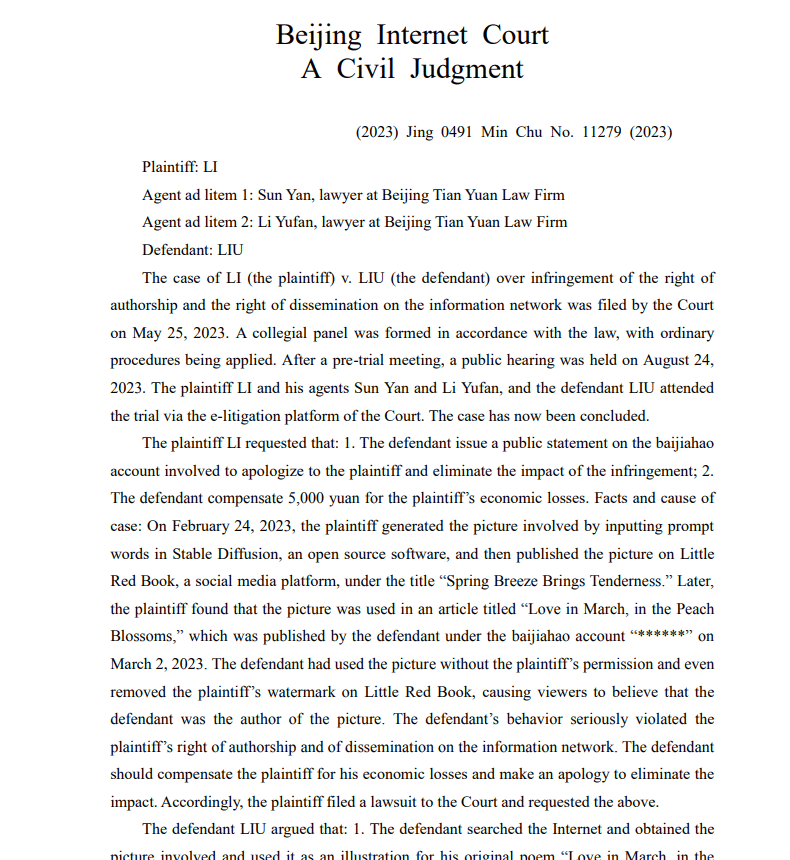
The dispute over the image “Spring Breeze Brings Tenderness” is a representative case in this field. According to the first-instance judgment of the Beijing Internet Court, the dispute focused on three key issues: whether the image constituted a protected work, whether the plaintiff owned the copyright, and whether the defendant’s conduct constituted infringement.
Read more of the judgment: https://english.bjinternetcourt.gov.cn/pdf/BeijingInternetCourtCivilJudgment112792023.pdf
Case No.: (2023)京0491民初11279号
I. Whether the Image Constitutes a Copyrightable Work
Can it be qualified as a “Work”?
The first issue was whether the disputed image qualified as a “work” under China’s Copyright Law.
The court examined the entire creative process and found that the plaintiff made intellectual contributions, including:
- Designing the manner in which the characters were presented;
- Selecting prompt words;
- Arranging the sequence of prompts;
- Setting relevant technical parameters;
- Choosing the image that met the expected result.
These activities constituted meaningful intellectual input.
The court further pointed out that generative AI models lack free will and legal personality. At the current stage, AI remains a technical tool. In essence, the creation process is “human creation using tools.”
Therefore, as long as an AI-generated image reflects original human intellectual contribution, it may be recognized as a protected work.
Classification as a Work of Fine Art
The court further held that the image was a planar artistic work composed of lines and colors with aesthetic value and should be classified as a work of fine art (“美术作品”, see more at Article 3 of the Chinese Copyright Law). Since it could be clearly categorized, the “other works” provision did not apply.
II. Whether the Plaintiff Owns Copyright
The second issue concerned copyright ownership.
Since AI models are not individual or legal entities (see more at Article 2 of the Chinese Copyright Law), they cannot be regarded as authors. They function only as technical tools.
The court held that copyright belongs to the person who makes the creative intellectual contribution. Although the image was generated by an AI system, the plaintiff conceived the idea, designed and arranged the prompts, adjusted parameters, and selected the final result.
Accordingly, the plaintiff was recognized as the author and copyright owner of the image.
III. Whether the Defendant’s Conduct Constituted Infringement
The third issue was whether the defendant’s unauthorized use constituted infringement.
The court found that the defendant used the image without permission, removed the watermark linked to the plaintiff, infringing upon the plaintiff’s copyright rights. No statutory defense applied.
The court ordered the defendant to:
- Cease the infringing conduct;
- Issue a public apology; and
- Compensate the plaintiff for economic losses.
The defendant was ultimately ordered to pay RMB 500 in damages.
Conclusion
The “Spring Breeze Brings Tenderness” case provides important guidance on the copyright protection of AI-generated works in China.
It confirms that:
- AI-generated works may be protected if they reflect AI users’ originality.
- Users who control the creative process may be recognized as authors.
- Unauthorized use may result in civil liability, including damages and apology obligations.
The judgment reinforces a human-centered approach to copyright protection and reflects China’s effort to adapt traditional legal principles to emerging technologies.