Last updated: 2026-10-29
Copyright protection in China is automatic: a work is protected from the moment it is created, and no registration is required. Registration is nonetheless strongly recommended, because a Copyright Registration Certificate issued by the Copyright Protection Centre of China (CPCC) is the standard evidence of ownership used in Chinese courts, before China Customs, and on e-commerce platforms such as Alibaba, Tmall and JD.com. Registering a general work costs from ¥100 to ¥2,000 per work, takes about 25 working days after acceptance, and software copyright registration is free of official fees.
Key takeaways
- Automatic protection. Under Article 2 of the Copyright Law, protection arises on creation. Registration is voluntary, not mandatory — but it is the practical prerequisite for fast enforcement.
- Governing law. The Copyright Law of the PRC (1990; amended 2001, 2010, 2020). The 2020 amendment took effect on 1 June 2021 and raised statutory damages to ¥5,000,000.
- Where to file. The Copyright Protection Centre of China (CPCC), the national registry designated by the National Copyright Administration. Software registration is handled exclusively by the CPCC.
- How long. 25 working days from acceptance for general works; 30 working days for computer software. This is faster than most foreign registries.
- How much. From ¥100 (short text works) to ¥2,000 (films and compilations). Art and photographic works: ¥300. Software copyright registration fees have been abolished since 1 April 2017.
- How long it lasts. The author’s life plus 50 years for individual authors; 50 years from creation for legal entities.
- Enforcement. Three parallel tracks — administrative (local copyright offices), civil (damages up to ¥5 million, plus punitive damages of 1–5×) and criminal.
- Foreigners qualify. Works of authors from Berne Convention member states are protected, and foreign nationals may register directly with the CPCC.
Whether you are an author, a software company, a brand owner or a manufacturer sourcing in China, this guide explains which works qualify, what documents you need, how the filing works, what it costs and how long protection lasts.
Is Copyright Protection Automatic in China, or Do You Need to Register?
Copyright protection in China is automatic. Under the Copyright Law of the People’s Republic of China, a work is protected from the moment it is created and fixed in a tangible form — no registration, no copyright notice and no deposit is required.
Registration is nevertheless the single most useful step a rights holder can take. A Chinese court does not require a registration certificate to accept a copyright claim, but in practice the CPCC certificate shifts the burden of proof: it establishes authorship, ownership and the date of creation on the face of an official document, which is exactly what enforcement bodies ask for.
Registration matters most in three situations:
- E-commerce takedowns. Alibaba, Tmall, JD.com and Amazon’s Chinese marketplace require a registration certificate (or a well-documented alternative) before they will remove infringing listings.
- Customs seizures. To record IP with China Customs and intercept counterfeit goods at the border, a registration certificate is the standard supporting document.
- Litigation and licensing. When you sue for damages, assign the copyright, or use the copyright as collateral for a pledge registered with the CPCC, the certificate is the document the counterparty and the court expect to see.
Practical note. Automatic protection gives you the right; registration gives you the proof. In China, the gap between the two is where most foreign rights holders lose cases.
What Law Governs Copyright in China?
China’s copyright system rests on domestic legislation and international treaties.
Domestic law
The Copyright Law of the People’s Republic of China was enacted in 1990 and amended in 2001, 2010 and most recently in 2020, with the current version in force since 1 June 2021. The 2020 amendment made three changes that matter to rights holders:
- It redefined a protected “work” as an intellectual achievement that is original in literature, art and science and can be expressed in a certain form, deliberately leaving room for new categories of work.
- It raised the ceiling for statutory damages to ¥5,000,000 (previously ¥500,000).
- It introduced punitive damages of one to five times the assessed amount for intentional, serious infringement.
Related instruments include the Regulations for the Implementation of the Copyright Law, the Computer Software Protection Regulations and the Measures for Voluntary Registration of Works.
International treaties
- The Berne Convention for the Protection of Literary and Artistic Works — China has been a member since 1992. It guarantees national treatment and requires no formalities as a condition of protection.
- The WTO TRIPS Agreement — sets minimum standards for copyright protection and enforcement that China applies through its domestic law.
- The WIPO Copyright Treaty (WCT) and WIPO Performances and Phonograms Treaty (WPPT) — both acceded to by China in 2007, extending protection to the digital environment.
Which Works Are Eligible for Copyright Protection in China?
Chinese law protects a broad and open-ended list of works. Article 3 of the Copyright Law expressly covers:
- Written works — books, articles, reports, manuscripts, marketing copy
- Oral works — speeches, lectures, sermons, other unscripted verbal expression
- Musical, dramatic, quyi, choreographic and acrobatic works — scores, lyrics, scripts, stage works, dance notation
- Fine art and architectural works — paintings, calligraphy, sculpture, building designs
- Photographic works — artistic and professional photographs
- Audiovisual works — films, television, short-form video, multimedia content
- Graphic works and models — engineering drawings, product designs, maps, schematic diagrams, scale models
- Computer software — source code and object code, protected under the Computer Software Protection Regulations
- Other intellectual achievements that meet the originality requirement
Three points decide whether a work qualifies: it must be original, it must be a product of intellectual creation, and it must be capable of being expressed in a certain form. Ideas, procedures, methods, systems and purely functional features are NOT protected — this is why software is best protected by both copyright (for the code) and, where available, patent or trade secret protection (for the logic).
Can Foreigners Register Copyright in China?
Yes. Foreign authors and foreign-owned companies can register works with the CPCC in their own name, and foreign works are protected in China without registration if either test below is met.
Protection without registration (Berne Convention)
- Nationality or habitual residence — the author is a national or habitual resident of a Berne member state; or
- Place of publication — the work is first published in China or in another Berne member state, or published simultaneously in a member state and a non-member state.
Practical requirements for foreign applicants
- Documents in a foreign language (other than the work sample itself) must be translated into Chinese.
- ID proof (certificate of incorporation, passport) is NOT required to be notarised and legalised.
- A local Chinese agent is not legally required, but is strongly advisable in practice for correspondence, payment and delivery of the certificate.
What Documents Are Required for Copyright Registration in China?
To register with the CPCC you will generally need the following:
- Application form — completed and signed, submitted through the CPCC online system, identifying the work, the author and the copyright owner. Please fill out the instructions for us to collect your application info.
- A sample of the work
- General works — one copy of the work, e.g. the manuscript, artwork or recording.
- Computer software — the first and last 30 consecutive pages of source code (60 pages total), plus documentation such as a user manual. If the source code is shorter than 60 pages, submit all of it.
- Proof of identity
- Individuals — a copy of a national ID card or passport.
- Companies and other legal entities — a copy of the business licence or certificate of incorporation.
- Proof of ownership, if applicable — where the applicant is not the original author (assignment, inheritance, commissioning or employment), provide the assignment/ emplopyment contract, a statement from the author that vests copyright in the applicant.
- Description of the work — a short statement of the work’s purpose, how it was created and what makes it original. For software, also state minimum hardware requirements, the operating system and the development environment.
- Power of attorney — required if filing through an agent, together with the agent’s identification document.
If the application is defective, the CPCC issues a correction notice, and the applicant has to submit corrections timely.
How to Register a Copyright in China: Step by Step
The procedure is the same for most work categories and runs entirely through the CPCC.
- Submit the application. File online through the CPCC portal.
- Pay the official fee. After the CPCC accepts the filing, it issues a fee notice. Pay once notified — not before. Software registration carries no official fee.
- Examination. The CPCC reviews the application for formal compliance and examines the work sample. If defects are found, a correction notice is issued and you have 30 days to respond.
- Certificate issued. On approval the CPCC issues a Copyright Registration Certificate, which is published on its website. Electronic and paper certificates have the same legal effect.
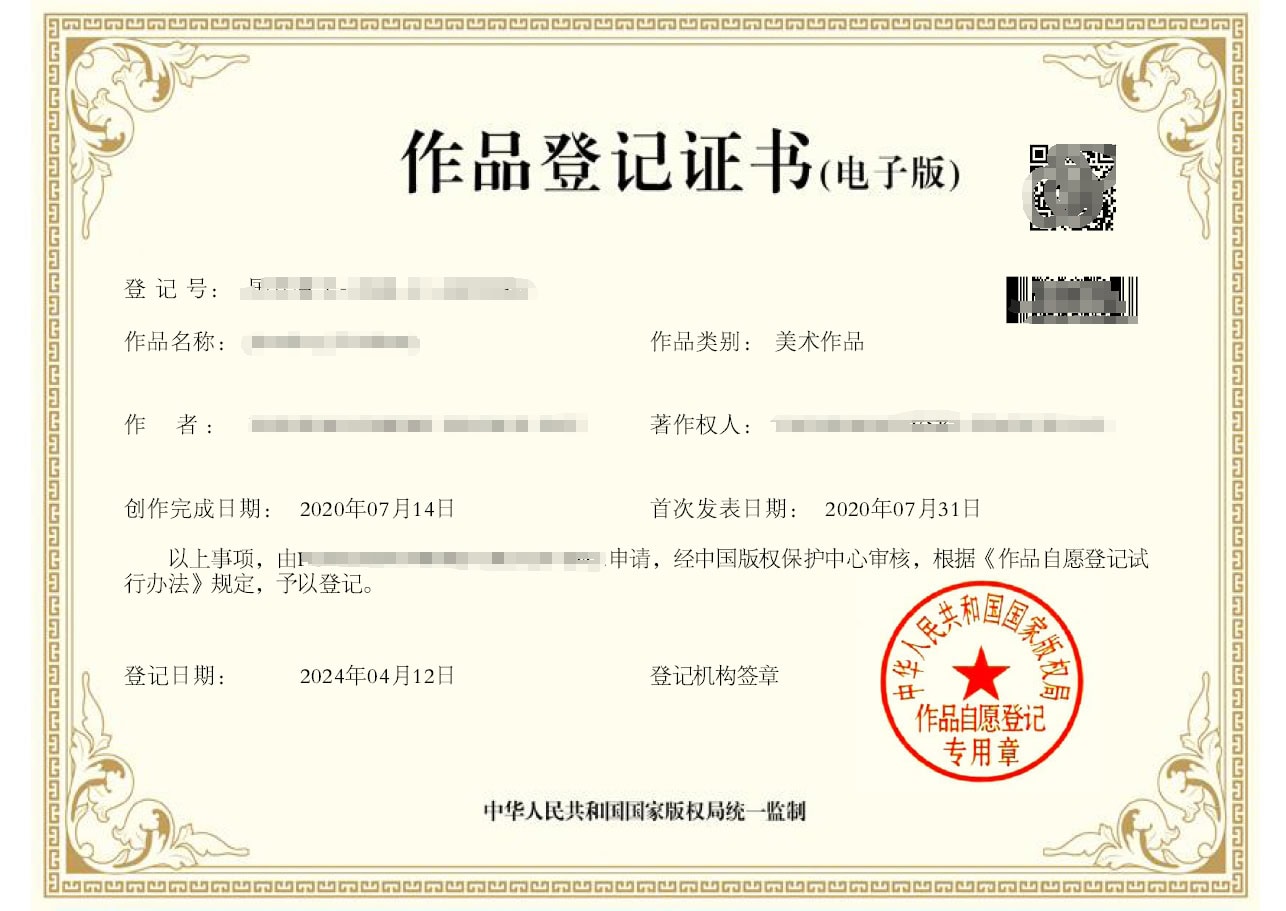
Chinese copyright registration certificate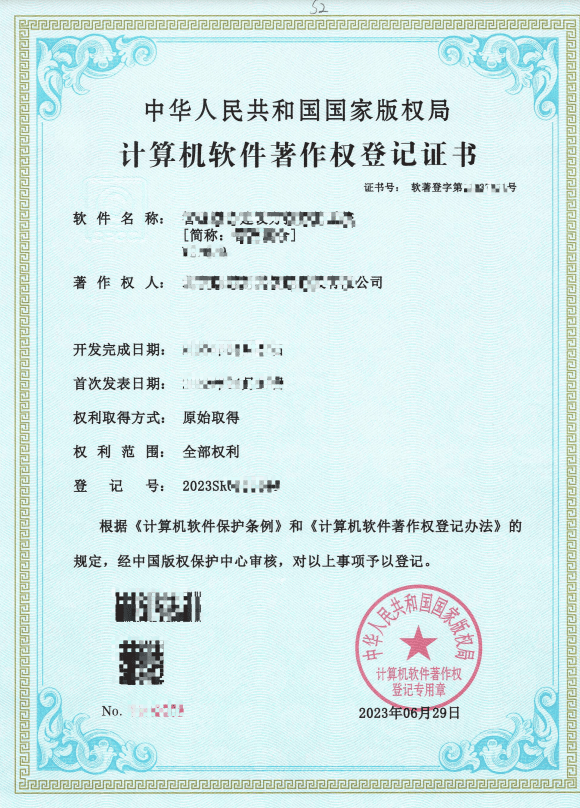
Chinese copyright registration certificate (for computer software)How Long Does Copyright Registration Take in China?
China’s copyright registry is fast by international standards.
| Application type | Official processing time |
| General works (literary, art, photographic, etc.) | 25 working days from acceptance |
| Computer software | 30 working days from acceptance |
| Reissue or replacement of a certificate | 5 working days from acceptance (shortened from 30 with effect from 12 August 2024) |
| Corrections after a correction notice | 30 calendar days to respond |
These are official CPCC processing times and exclude preparation, translation and legalisation of foreign documents. For a foreign applicant, budgeting 6 to 10 weeks end to end is realistic, most of it spent on notarisation and apostille rather than on examination. There is no substantive novelty examination — unlike a patent application, the CPCC does not search prior works.
How Much Does Copyright Registration Cost in China?
The CPCC applies a published voluntary registration fee schedule (last revised 26 October 2018). Fees are charged per work.
| Work type | Official fee (RMB) |
| Written and oral works — under 100 characters | ¥100 |
| Written and oral works — 101–5,000 characters | ¥150 |
| Written and oral works — 5,001–10,000 characters | ¥200 |
| Written and oral works — over 10,000 characters | ¥300 |
| Musical works (words and music / music only) | ¥300 / ¥200 |
| Drama, quyi, choreography, acrobatics | ¥300 each |
| Fine art works | ¥300 |
| Photographic works | ¥300 |
| Engineering and product design drawings | ¥500 |
| Maps and schematic diagrams | ¥500 |
| Model works | ¥500 |
| Architectural works | ¥1,500 |
| Cinematographic works | ¥2,000 |
| Compilations, multimedia compilations, other works | ¥2,000 |
| Sound recordings — songs / albums | ¥300 per song / ¥2,000 per album |
| Video recordings | ¥300 (first 30 min) + ¥100 per additional 30 min |
| Typeface and layout designs | ¥500 |
| Radio and television programmes | ¥300–¥800, by duration |
| Second and subsequent works in a series | ¥100 per work |
| Amendment or change of registration | 50% of the registration fee |
| Replacement certificate | ¥50 per copy |
| Cancellation of registration | ¥80 |
| Certificate postage | ¥15–¥22 (registered mail / EMS) |
Computer software is free. Since 1 April 2017, the CPCC has stopped charging software copyright registration fees, following the Ministry of Finance and NDRC notice abolishing 41 central administrative charges (Caishui [2017] No. 20). No registration fee, certificate fee or inquiry fee is charged for software filings.
How Long Does Copyright Protection Last in China?
| Rights holder | Scope | Term |
| Individual author | Economic rights and, subject to limits, moral rights | Life of the author + 50 years, ending on 31 December of the 50th year after death |
| Legal entity or unincorporated organisation | Economic rights | 50 years from creation, ending on 31 December of the 50th year after creation; if the work is not published within that 50-year period, protection lapses |
| Audiovisual works | Economic rights | 50 years from first publication |
| Anonymous or pseudonymous works | Economic rights | 50 years from first publication |
Two rules deserve attention. Moral rights — the right of attribution, publication, integrity and alteration — are perpetual for natural persons and do not expire. And the 50-year entity term runs from creation, not publication, so an unpublished corporate work can fall out of protection while still commercially valuable.
How Is Copyright Enforced in China?
China offers three enforcement tracks that a rights holder can pursue in parallel.
| Track | Who handles it | What you can get | Typical use |
| Administrative | Local copyright offices at the district, city and provincial level | Orders to stop infringement, confiscation and destruction of infringing copies, fines | Fast, low-cost action against physical piracy and print runs |
| Civil | Intermediate and IP courts | Injunctions, damages, order to cease infringement, public apology | The main route for commercial-scale claims and for licensing disputes |
| Criminal | Public security and people’s procuratorate | Fines and imprisonment, typically where turnover or illegal gain exceeds ¥30,000–¥50,000, or where the number of infringing copies is large | Large-scale piracy and counterfeiting operations |
Damages are calculated under Article 54 of the Copyright Law in a fixed order:
- The rights holder’s actual loss;
- if that cannot be established, the infringer’s illegal gain;
- if neither can be established, a multiple of the applicable royalty (rights usage fee);
- if none of the above can be determined, statutory damages between ¥500 and ¥5,000,000 at the court’s discretion;
and for intentional infringement committed in serious circumstances, the court may award punitive damages of one to five times the amount determined above. Reasonable enforcement costs, including attorneys’ fees, are recoverable separately.
Evidence is the deciding factor. In practice, your strongest bundle is the creation draft or source file, the first publication record, and the CPCC registration certificate — together they establish both authorship and priority.
Copyright in China: Automatic Protection vs. Registration
| Automatic protection (no filing) | CPCC registration | |
| Legal effect | Full copyright subsists from creation | Evidentiary presumption of ownership and authorship |
| Cost | None | ¥100–¥2,000 per work; software free |
| Time | Immediate | 25–30 working days from acceptance |
| Required? | No | No, but expected by platforms, Customs and courts |
| Evidence value | Depends on your own records | Official document, publicly searchable |
| Best for | Early-stage works, drafts, internal material | Anything you intend to license, sell, enforce or pledge |
Frequently Asked Questions
No. Protection is automatic from the moment the work is created, and China — as a Berne Convention member — imposes no formalities. Registration is voluntary, but it is the evidence that enforcement bodies and platforms expect.
From ¥100 to ¥2,000 per work depending on the category: ¥300 for fine art and photographic works, ¥500 for design drawings and maps, ¥1,500 for architectural works, ¥2,000 for films. Software copyright registration carries no official fee.
25 working days from acceptance for general works and 30 working days for computer software. Replacement certificates take 5 working days.
Yes. Foreign individuals and companies may register directly with the CPCC. Foreign-language documents must be translated into Chinese, and the company’s incorporation documents must be notarised and legalised, or apostilled under the Hague Apostille Convention.
Yes. The CPCC has not charged software copyright registration fees since 1 April 2017, when the software copyright registration fee was abolished as one of 41 central administrative charges.
Both are issued by the CPCC and have the same evidentiary status. The software certificate covers source code and documentation and is the document requested for software-related disputes, high-tech enterprise certification and software product registration in China.
For individual authors, the author’s life plus 50 years. For companies and other legal entities, 50 years from creation — and if the work is not published within those 50 years, it ceases to be protected. Moral rights of natural persons are perpetual.
China does not recognise a foreign copyright registration as a substitute for a Chinese one. A US or EU registration is useful evidence of creation, but for enforcement in China you will want a CPCC certificate or equivalent local evidence.
Only where the output reflects sufficient human intellectual investment. The CPCC examines originality, and Chinese courts have granted protection where a human’s selection, arrangement and creative input can be documented. Purely machine-generated output with no human creative contribution is not registrable.
Read more: AI-Generated Works and Copyright in China: The “Spring Breeze Brings Tenderness” Case
Collect the registration certificate, the creation evidence and proof of the listing, then file a takedown through the platform’s IP protection portal.
Read more: How to Remove Counterfeits From Alibaba
Yes, once you hold a Chinese registration certificate. Recordation allows Customs to detain suspected infringing goods at the border on its own initiative or on your application.
Read more: How to protect your intellectual property through China Customs?
Registration in China establishes evidence of ownership in China. Abroad, your Chinese certificate serves as strong evidence of creation, but enforcement abroad depends on the local law of the country in question — often automatic under the Berne Convention.
Official sources
- Copyright Law of the People’s Republic of China — National Copyright Administration of China
- Copyright Protection Center of China
- Berne Convention — World Intellectual Property Organization
Ready to secure your copyright in China? Let us help you navigate the process efficiently. Reach out to us now for personalized consultation and professional support!